
Add a city, a capability or scale what works.
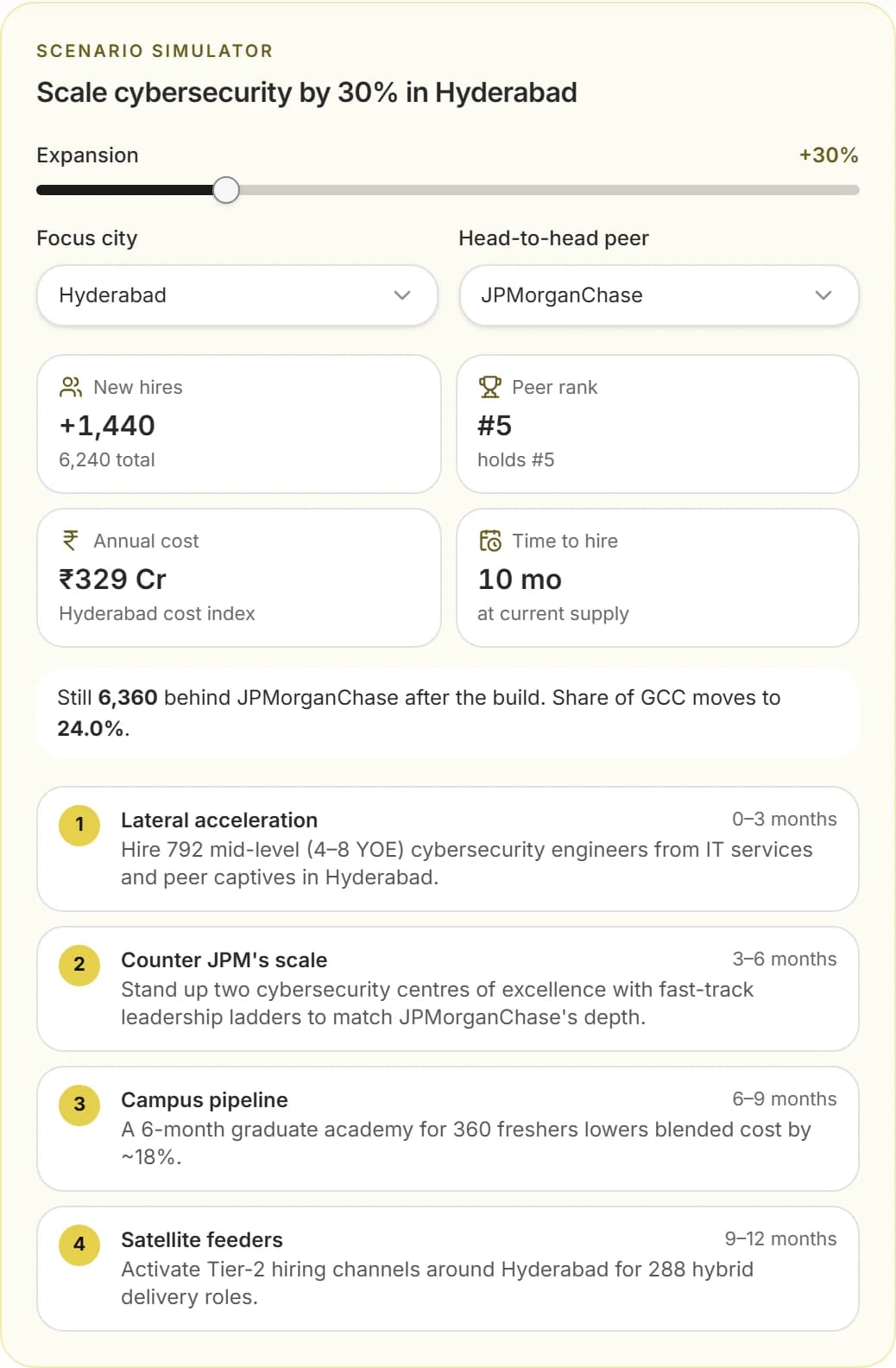
Expansion is a different decision from a first build: you already have a cost base, a leadership team and a brand in the market. CapSight starts from where you are, and shows what a new location would cost, who you would compete with there and how peers sequenced their own expansions.
 Sample data
- Compare a new city against the one you run today
- See which peers already operate where you are looking
- Pace growth against hiring activity, not intuition
The GCC list this page draws on.
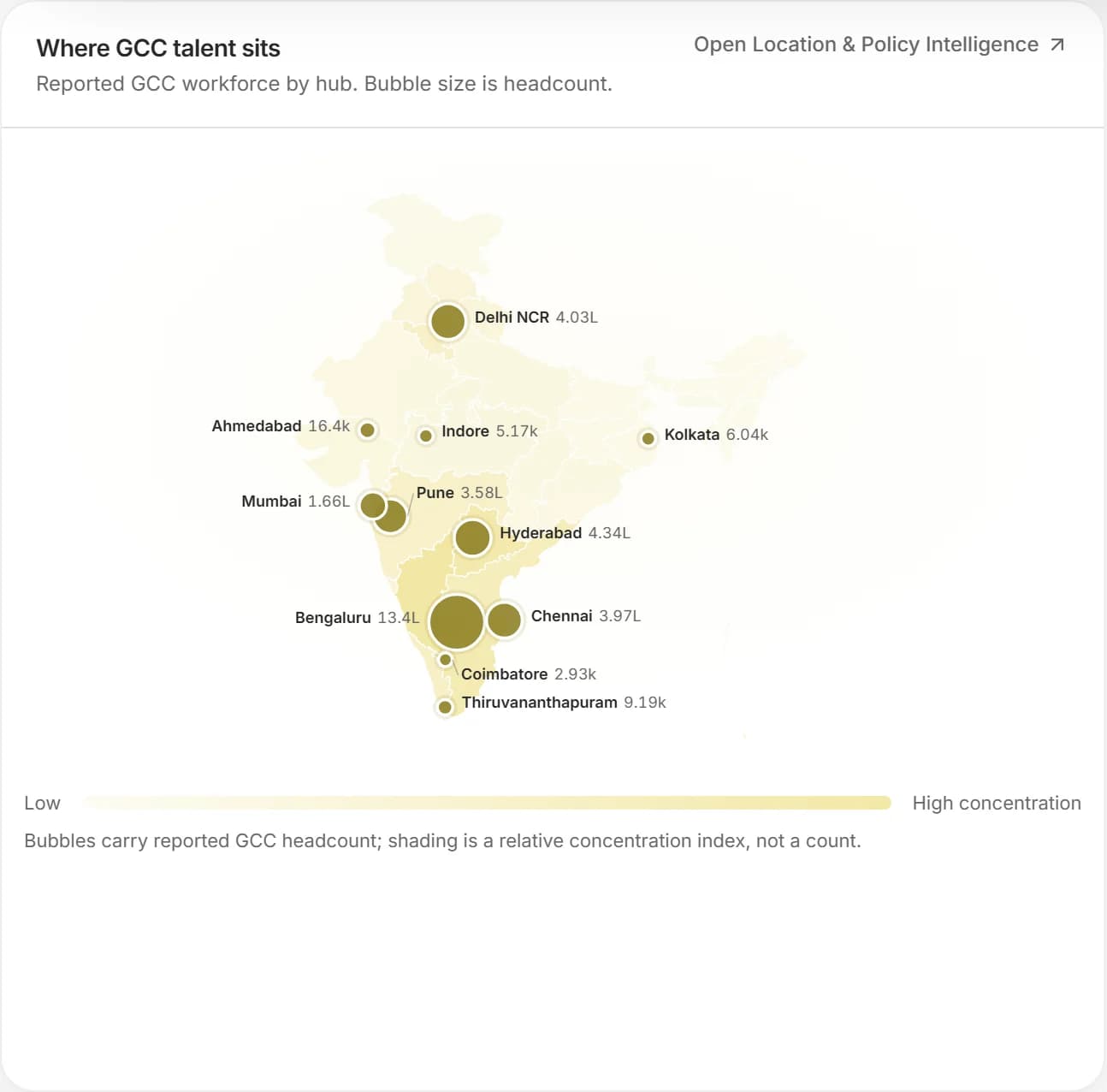
Where the workforce sits today, hub by hub.
A screen from the product itself. The counts beside it are read from the platform directory.
- 2,500
- company profiles
- 35
- Indian cities with a centre
- 28
- documented build journeys
- 1,296
- companies with pay benchmarks
Expand a GCC, in four parts.
Each part is something the product does today, with the data it uses named on the page.
A second-location case
Set a candidate city beside your current one on annual pay for the same role and band, hiring activity and office market, so the saving or the premium is a number, not a story.
Peer footprints
See which companies run centres in each city and how large they are, so you know whose hiring you will meet and whose people you may recruit.
Capability add-ons
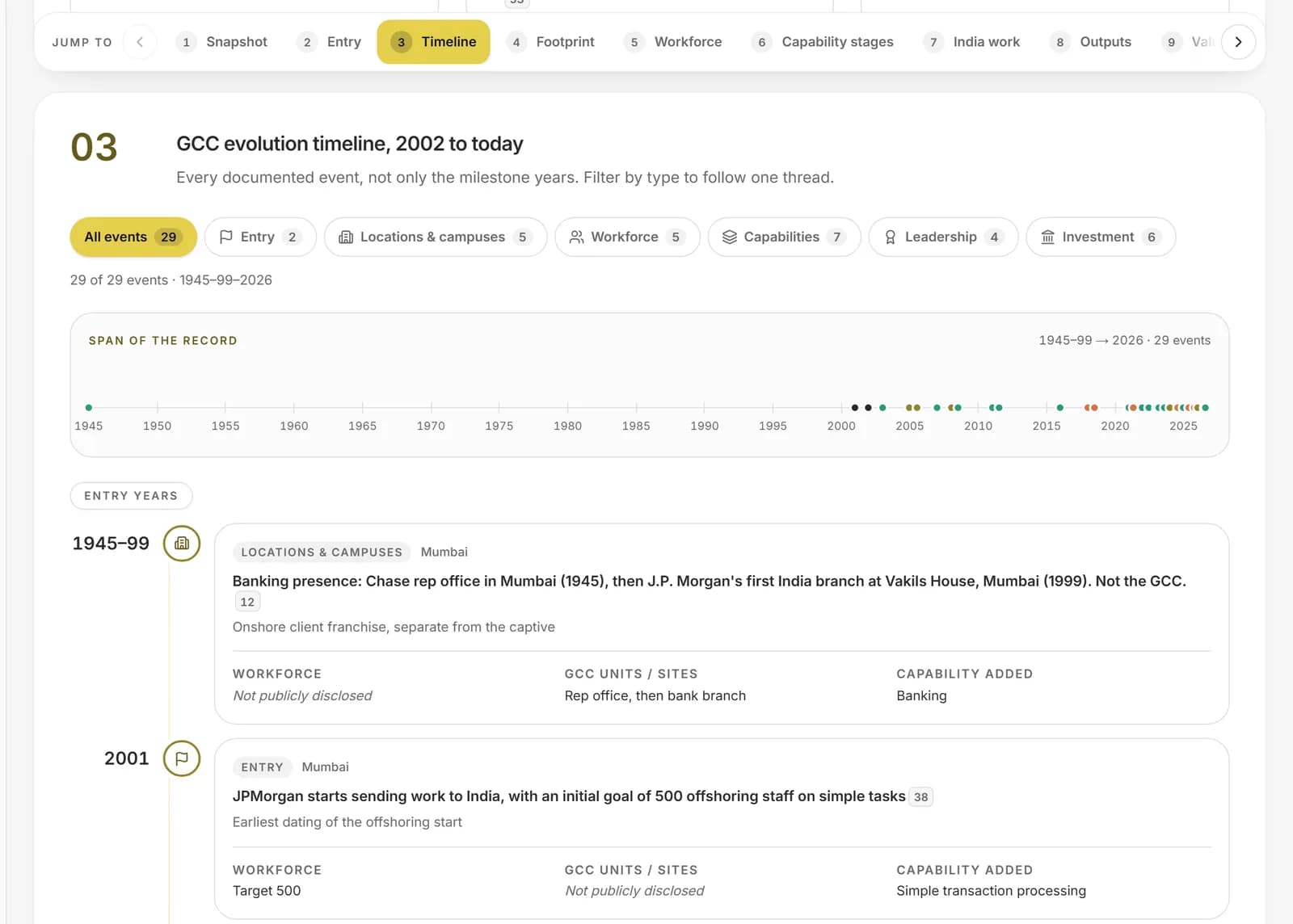
Look at how documented centres added capabilities over time, and which cities took which new mandates.
Pacing that matches the market
Read month-on-month hiring activity for your roles over 30, 60 and 90 days, so a ramp plan reflects how crowded the market is.

One market, twelve decisions.
The same list of GCCs, the same cities and the same pay benchmarks sit under every solution, so where to build, what to build, what to pay and whom to hire are answered from one set of facts that agree with each other.
Request access- 0
- Mega GCCs, over 10,000 people each
- 0
- GCCs set up since 2021
- 0
- States and union territories with a centre
- 0.00M
- GCC workforce on the list
Tier 1 and Tier 2, the way the market reads them
The product splits Indian locations into eight Tier 1 hubs and every other named city, and applies the split to expansion news, hubs and reports.
- 01
Bengaluru
Tier 1. The deepest base of centres; most documented journeys started here.
- 02
Hyderabad
Tier 1. A fast-growing second hub in the documented journeys.
- 03
Pune
Tier 1. Strong in engineering and shared services.
- 04
Chennai
Tier 1. Established across engineering, BFSI and operations.
- 05
Mumbai
Tier 1. Finance and corporate functions.
- 06
Delhi NCR
Tier 1. Gurugram, Noida and the rest of the region read as one hub.
- 07
Kolkata
Tier 1. A deep talent base with a growing set of centres.
- 08
Ahmedabad
Tier 1. Home to GIFT City and a widening mix of finance and operations centres.
- 09
Every other named city
Tier 2. Compared with the same pay and hiring views as the eight above.
Ask the question the way you would ask a colleague.
These are the kinds of questions this page is built for. Each one is answered from the data on it, not from a general model of the market.
What would the same team cost in Pune or Hyderabad compared with where we are today?
Which of our peers already run centres in the city we are considering, and how large are they?
Is hiring for this role heating up or cooling down over the last 30, 60 and 90 days?
Which cities took new mandates and capabilities in documented expansions?
How many of the documented journeys ended up in more than one city, and how did they sequence them?
Which Tier 2 cities are showing new GCC announcements?
From first look to a decision you can show.
Start from your centre
Pick the city and capability you run today as the baseline.
Compare candidates
Put one or two candidate cities against it on pay, hiring and policy.
Check who is already there
Read the peer footprints in each candidate city before you commit.
Set the ramp
Use hiring activity over 30, 60 and 90 days to pace the plan, and capture it in a report.
Built for the people who own the decision.
GCC leadership
A reasoned case for the next location or capability.
Talent acquisition heads
A realistic hiring ramp in a market with known competitors.
Finance partners
The cost difference between the current and the proposed city.
What is in it, and what is not yet.
We say plainly what the data holds today and what we are still adding, so nothing here is implied.
- Annual CTC by city, role and experience band
- Hiring activity by city, function and role with month-on-month change
- Peer centres and headcount bands by city
- Expansion news with a Tier 1 and Tier 2 view
- 28 documented journeys, 25 of which now span more than one city
- Lease-level real-estate cost per seat
- Attrition by city
The terms on this page, defined.
Every figure on a CapSight page comes with its definition, so you never have to guess what a number is counting.
- GCC
- A Global Capability Centre: a centre a company runs in India for its own global work, such as engineering, analytics, finance, operations or support. It is part of the company, not an outside vendor.
- Platform Industry
- The one industry grouping CapSight uses for every company, so a filter or a chart means the same thing on every page. There are 10.
- Tier 1 and Tier 2 cities
- Tier 1 is the eight established hubs: Bengaluru, Chennai, Hyderabad, Mumbai, Pune, Delhi NCR, Kolkata and Ahmedabad. Every other city is Tier 2.
- CTC
- Cost to company: the annual total an employer commits to one person, shown in lakh rupees. One lakh is 100,000.
- Percentile band (P25, P50, P75, P90)
- P50 is the median: half the people in the sample earn less. P25 and P75 mark the edges of the middle half, and P90 marks the top tenth. A pay figure is always read with its band.
- Build journey
- A documented account of how a comparable centre started: its first city, its first team and how it grew, with each figure cited to its source.
Before you ask.
Is the Tier 1 and Tier 2 split fixed?
Tier 1 is Bengaluru, Chennai, Hyderabad, Mumbai, Pune and Delhi NCR. Every other named city is Tier 2. Stories that name no city appear only under All.
Can I compare more than two cities?
Yes. The hub and state comparisons take several cities at once.
Does it cover companies without a published headcount?
Companies appear with the headcount band the data holds; where none is held the profile says so.
Bring the GCC decision you are working on.
Where to put the next 300 engineers, what a peer pays its architects, who owns the charter you are selling into. Ask it in CapSight, and see the market, the peers and the people behind the answer.
Already on CapSight? Sign in
- 01Request access
We set up your organisation and its admin, who adds the team.
- 02Ask the question you have
Market, peer, pay or people, answered from one dataset.
- 03Walk it through with us
A 30-minute session with the research desk, on your decision.

Capability maturity of five BFSI GCCs in Bengaluru, by function.
Illustrative example