
Decide where, what and whom before you commit.
A first centre is four decisions that depend on each other: the city, the capability, the pay you will carry and the leaders you need. CapSight puts the evidence for all four in one place, so the case for a build is made from the market and from how comparable centres actually started.
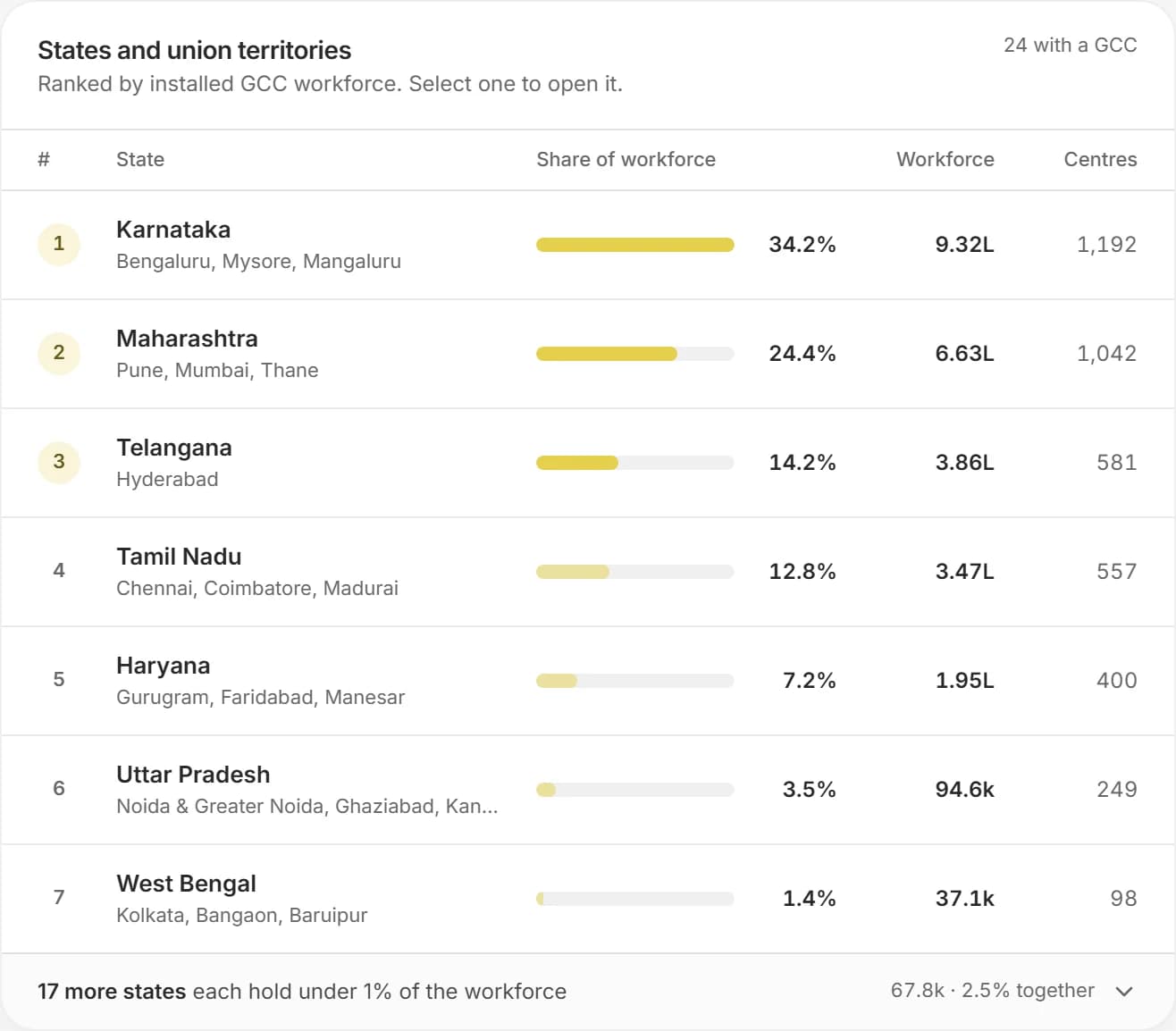
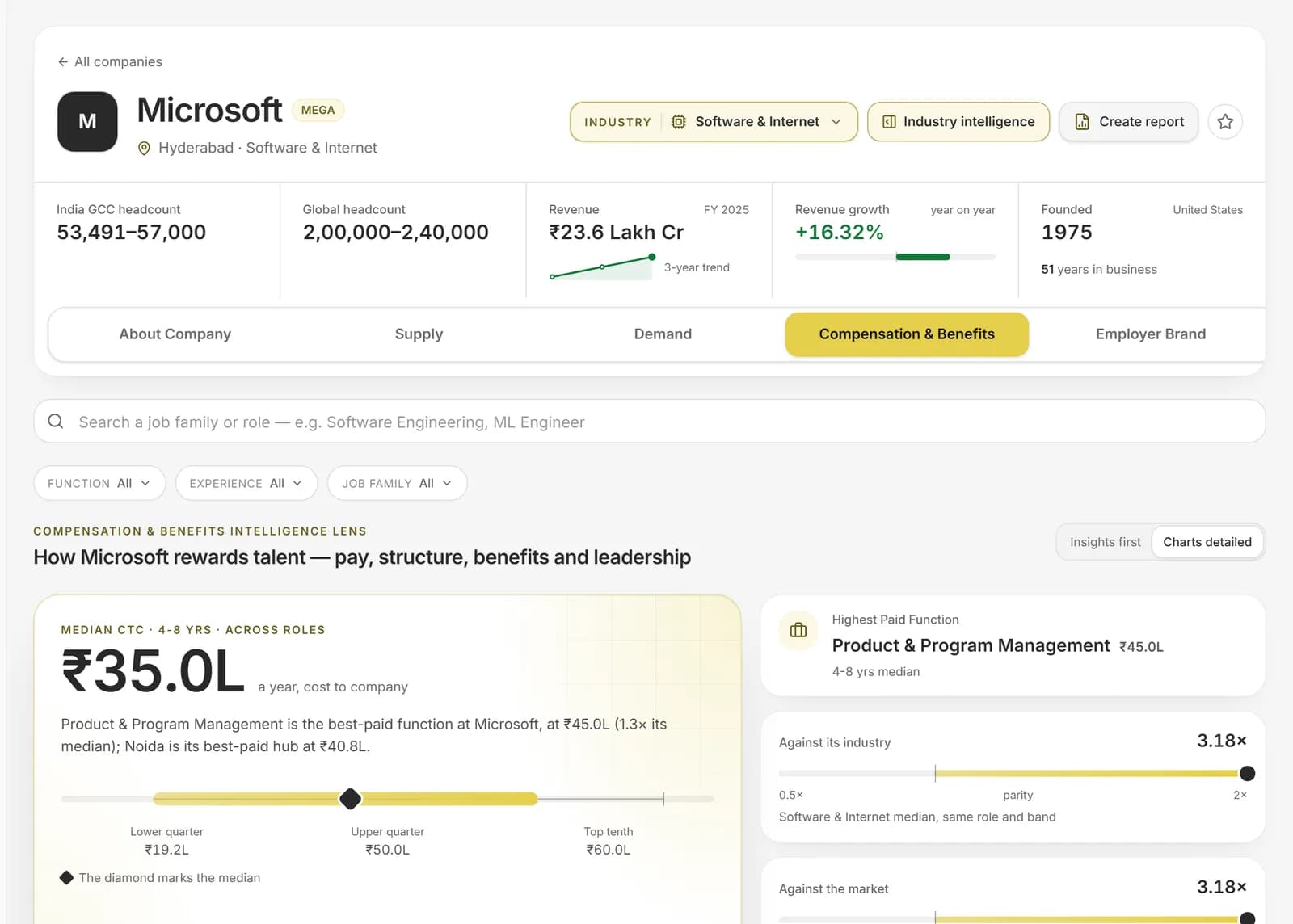
- A location shortlist built on pay, hiring and policy
- How documented peer centres started, city by city
- Pay for the roles you will hire, by city and band
The GCC list this page draws on.
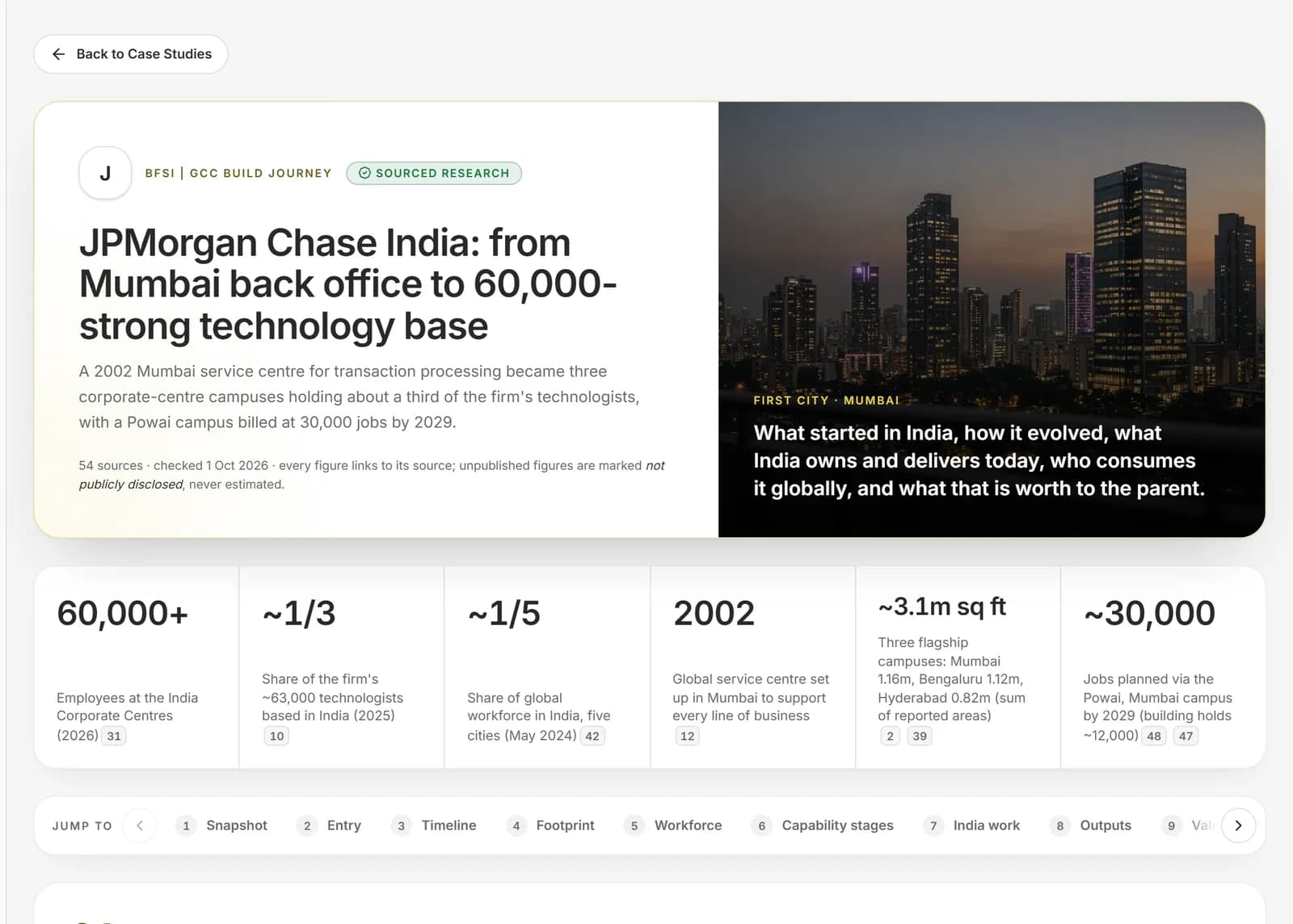
How a comparable centre started, with every figure sourced.
A screen from the product itself. The counts beside it are read from the platform directory.
- 2,500
- company profiles
- 35
- Indian cities with a centre
- 28
- documented build journeys
- 1,296
- companies with pay benchmarks
Build a GCC, in four parts.
Each part is something the product does today, with the data it uses named on the page.
A location shortlist you can defend
Compare hubs and states side by side on hiring activity, annual pay for the same role and band, state incentive policy and office market, then narrow to two or three cities with the numbers next to each.
A first centre modelled on real ones
28 documented build journeys show the first city, the year, the size of the first team where it was published and how the centre grew. Every figure carries its source, so you see how a comparable centre started, not a generic playbook.
A pay envelope for the roles you need
Annual CTC at the 25th, 50th, 75th and 90th percentile for your role and experience band in each shortlisted city, with the benchmark for your industry beside the market's.
The people who have done it before
Leaders of comparable centres and the organisations they run, so you know whom to learn from and whom you will compete with for talent once you open.

One market, twelve decisions.
The same list of GCCs, the same cities and the same pay benchmarks sit under every solution, so where to build, what to build, what to pay and whom to hire are answered from one set of facts that agree with each other.
Request access- 0.00M
- GCC workforce on the list
- 0.0%
- Of the workforce is in Bengaluru
- 0
- Mega GCCs, over 10,000 people each
- 0
- GCCs set up since 2021
Four answers that have to agree
A location decision made without the pay and the mandate behind it gets reopened later. The work runs in this order, and each step feeds the next.
- Step 1
Where to build
Hub and state comparison: hiring activity, centre presence, policy and real estate.
- Step 2
What to build
The capability and ownership model, set against how peers started.
- Step 3
What to pay
Annual CTC for the same role and band in every shortlisted hub.
- Step 4
Whom to source
The leaders and teams of comparable centres, once the scope is clear.
Ask the question the way you would ask a colleague.
These are the kinds of questions this page is built for. Each one is answered from the data on it, not from a general model of the market.
Which Indian cities should a first engineering centre consider, and what do peers' first centres look like in each?
How large were the first teams at comparable centres, and how fast did they grow?
Which states offer GCC incentives, and how do their terms compare?
What does the role I need cost in each shortlisted hub, at my experience band?
Is hiring for this role concentrated in one or two cities, or spread across the shortlist?
Which companies already run centres in my shortlist, and in what capabilities?
From first look to a decision you can show.
Frame the mandate
Name the capability, the scale and the timeline, the way a brief names them. Everything after is read against it.
Narrow the cities
Compare the candidate hubs and states on one screen, then keep the cities that hold up on pay, hiring and policy together.
Price the roles
Read the pay band for each role in each city at the experience level you will hire, and set the envelope.
Take it to a brief
Turn the shortlist into a designed report your leadership can read in one sitting, with the evidence on its pages.
Built for the people who own the decision.
Strategy and site-selection leads
A shortlist and a reasoned recommendation, not a long list of cities.
GCC heads and managing directors
The case for the next move, with peers' paths beside it.
Finance and total-rewards partners
A pay envelope per role and city before headcount is approved.
What is in it, and what is not yet.
We say plainly what the data holds today and what we are still adding, so nothing here is implied.
- 2,500 company profiles across 35 Indian cities
- 28 build journeys, each figure cited to its source
- Annual CTC percentiles by city, role and experience band
- State and city location profiles with incentive policy
- Hiring activity from job postings, by city and role
- CTC structure and benefits by company
- Talent-supply pools by function and seniority
The terms on this page, defined.
Every figure on a CapSight page comes with its definition, so you never have to guess what a number is counting.
- GCC
- A Global Capability Centre: a centre a company runs in India for its own global work, such as engineering, analytics, finance, operations or support. It is part of the company, not an outside vendor.
- Platform Industry
- The one industry grouping CapSight uses for every company, so a filter or a chart means the same thing on every page. There are 10.
- Tier 1 and Tier 2 cities
- Tier 1 is the eight established hubs: Bengaluru, Chennai, Hyderabad, Mumbai, Pune, Delhi NCR, Kolkata and Ahmedabad. Every other city is Tier 2.
- CTC
- Cost to company: the annual total an employer commits to one person, shown in lakh rupees. One lakh is 100,000.
- Percentile band (P25, P50, P75, P90)
- P50 is the median: half the people in the sample earn less. P25 and P75 mark the edges of the middle half, and P90 marks the top tenth. A pay figure is always read with its band.
- Build journey
- A documented account of how a comparable centre started: its first city, its first team and how it grew, with each figure cited to its source.
Before you ask.
Does CapSight recommend a city?
It gives you the evidence to compare cities and a report that lays it out. The recommendation is yours; the numbers behind it are on the page.
How current is the data?
Every view states its period. The pay benchmarks and skill premiums name the date they describe, and hiring activity updates as postings are collected.
Can we use this for a second or third centre?
Yes. See Expand a GCC, which starts from the centres you already run.
Bring the GCC decision you are working on.
Where to put the next 300 engineers, what a peer pays its architects, who owns the charter you are selling into. Ask it in CapSight, and see the market, the peers and the people behind the answer.
Already on CapSight? Sign in
- 01Request access
We set up your organisation and its admin, who adds the team.
- 02Ask the question you have
Market, peer, pay or people, answered from one dataset.
- 03Walk it through with us
A 30-minute session with the research desk, on your decision.

Capability maturity of five BFSI GCCs in Bengaluru, by function.
Illustrative example