
How a centre is seen by the people who work there.
Pay brings people to the door; reputation decides who walks in. CapSight shows reviewer ratings and themes for each company next to its pay position and hiring activity, so an employer-brand view is read together with the numbers that shape it.
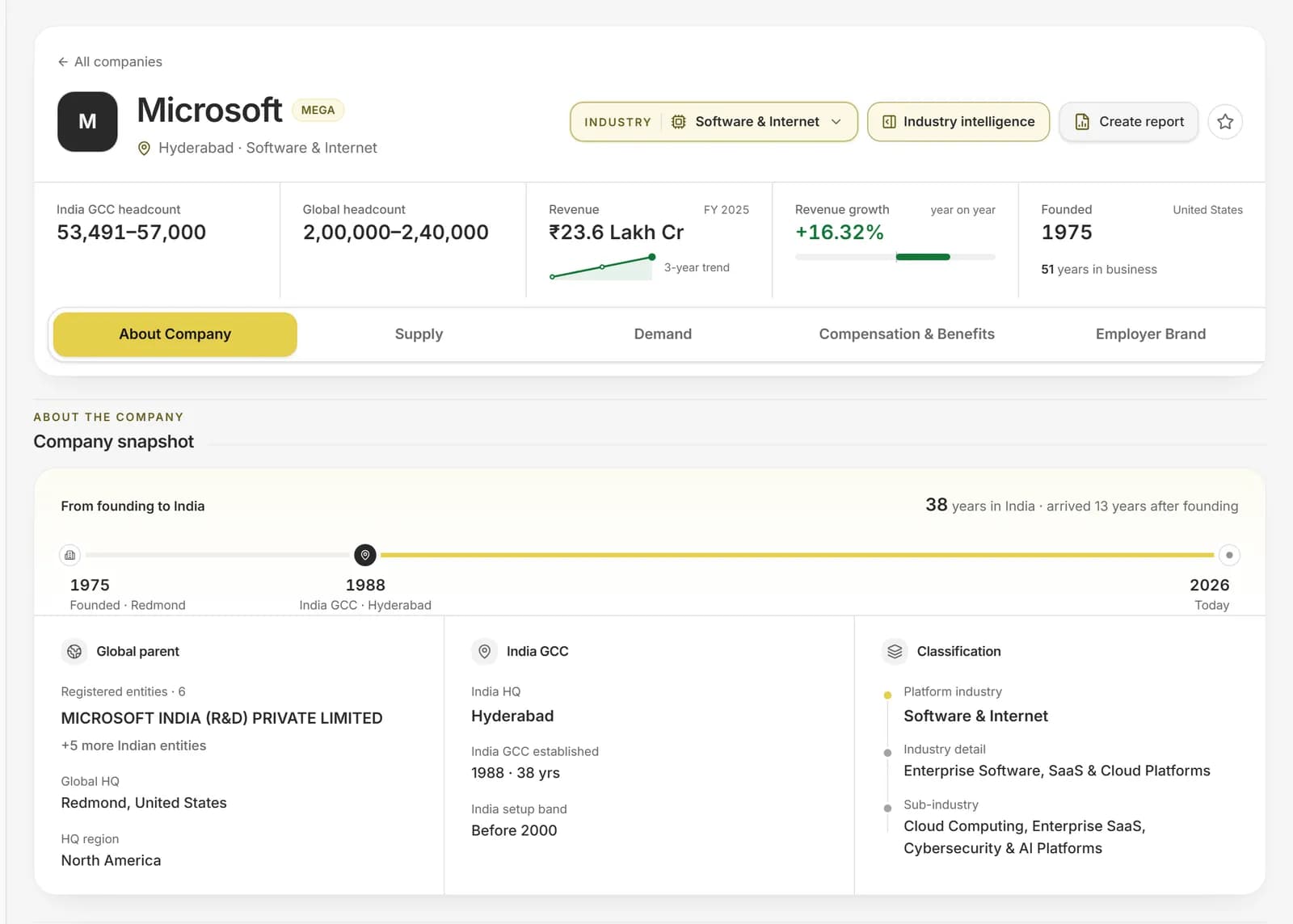
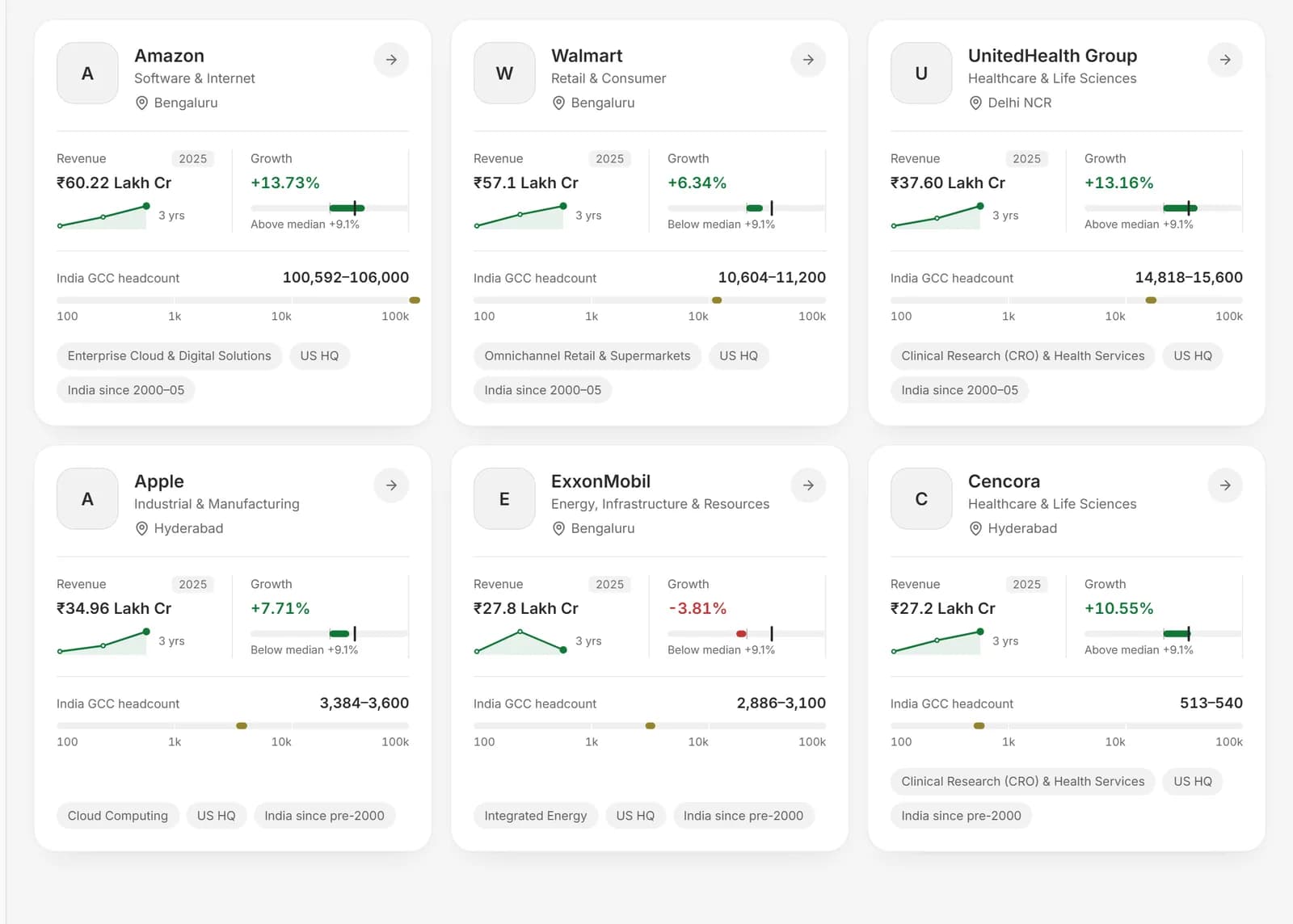
- Reviewer ratings from employee-review platforms
- Ratings read beside pay and hiring
- Honest gaps where no platform covers a company
The GCC list this page draws on.
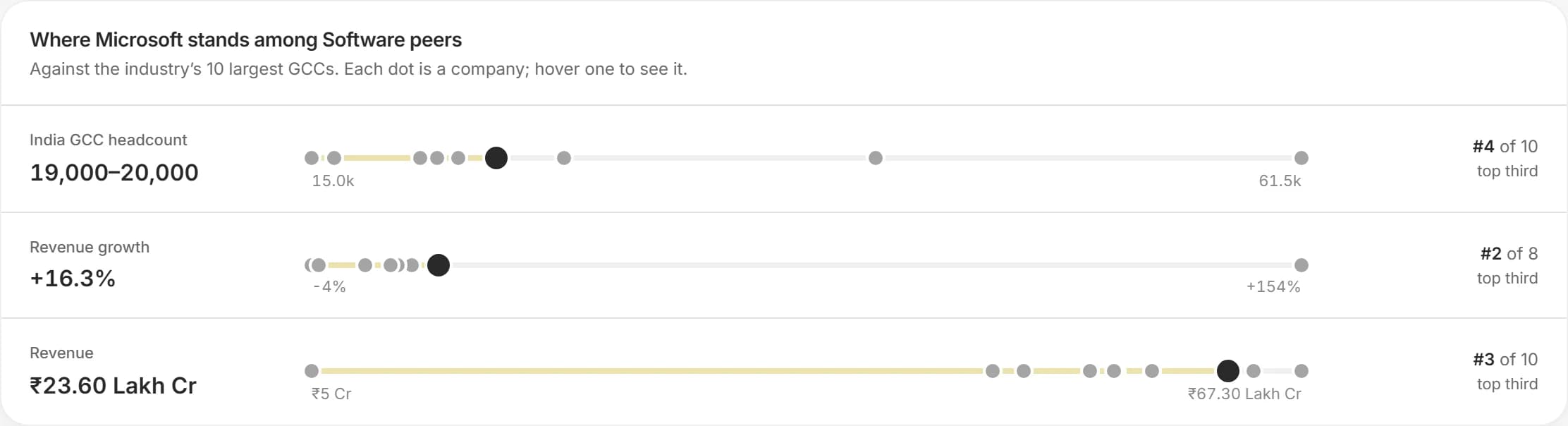
A company against its industry's largest GCCs.
A screen from the product itself. The counts beside it are read from the platform directory.
- 2,500
- company profiles
- 4,439
- GCC centres
- 35
- Indian cities with a centre
- 10
- platform industries
Employer Brand, in four parts.
Each part is something the product does today, with the data it uses named on the page.
Ratings per company
Overall and category ratings from reviewer platforms, for each company where coverage exists.
Beside the numbers
A company's rating sits on the same page as its median pay against the industry and its hiring activity, so a brand gap can be read against a pay or a demand gap.
Peer comparison
Compare a company's ratings with peers in the same Platform Industry or city.
No invented scores
A company no review platform covers shows no scores, and the page says so.

The market, company by company.
Every GCC on the list has a profile, and every profile rolls up into the cities, industries, skills and pay layers you filter by. Start from the whole market and narrow to one company, or start from one company and see the market around it.
Request access- 0.00M
- GCC workforce on the list
- 0
- States and union territories with a centre
- 0.0%
- Of the workforce is in mega GCCs
- 0
- GCCs set up since 2021
Reading employer brand with the evidence around it
The ratings are one input. Each row shows what to read them against.
- If the rating is...Below peersRead it againstPay position at the same bandIt may meanA pay gap, or something other than pay
- If the rating is...Strong, but hiring is slowRead it againstHiring activity by cityIt may meanA narrow talent pool rather than a brand problem
- If the rating is...Strong in one city, weak in anotherRead it againstCentre headcount by hubIt may meanA culture or leadership issue at one site
- If the rating is...Not coveredRead it againstPeers' coverageIt may meanToo few reviews to rate, not a poor reputation
Ask the question the way you would ask a colleague.
These are the kinds of questions this page is built for. Each one is answered from the data on it, not from a general model of the market.
How do employees rate this company compared with its industry peers?
Does a pay gap line up with a ratings gap?
Which categories drive a company's rating up or down?
Which peers are best rated in a given city?
Is a low rating on a company with few reviews meaningful?
From first look to a decision you can show.
Open the company
Go to its profile and the employer-brand section.
Read the ratings
Overall and category scores, with the platform named.
Set them beside pay and hiring
Check whether the story agrees across measures.
Compare with peers
See where the company ranks in its peer set.
Built for the people who own the decision.
Employer-branding and TA leaders
A view of how the centre is perceived against competitors.
HR leadership
Evidence for retention and offer decisions.
Recruiters
Talking points that match the market's view of an employer.
What is in it, and what is not yet.
We say plainly what the data holds today and what we are still adding, so nothing here is implied.
- Employee-review ratings where covered
- Ratings alongside pay position and hiring activity
- Review themes at city level
- Attrition and engagement data
The terms on this page, defined.
Every figure on a CapSight page comes with its definition, so you never have to guess what a number is counting.
- GCC
- A Global Capability Centre: a centre a company runs in India for its own global work, such as engineering, analytics, finance, operations or support. It is part of the company, not an outside vendor.
- Platform Industry
- The one industry grouping CapSight uses for every company, so a filter or a chart means the same thing on every page. There are 10.
- Tier 1 and Tier 2 cities
- Tier 1 is the eight established hubs: Bengaluru, Chennai, Hyderabad, Mumbai, Pune, Delhi NCR, Kolkata and Ahmedabad. Every other city is Tier 2.
- Operating centre
- A company's presence in one city. A GCC with centres in three cities has three, which is why centres outnumber GCCs.
- Setup year
- The year a company set up its India GCC, where it is recorded: 1,895 of 2,500 companies have one. It is the basis of the setup eras the skyline shows.
- Median and percentiles
- The median (P50) is the middle value: half the sample sits below it. Percentiles show the spread around it, so a median is never quoted without its band.
Before you ask.
Who provides the ratings?
Employee-review platforms; CapSight blends them weighted by review count.
Why is a company missing scores?
Because neither platform covers it with enough reviews. The product does not substitute an estimate.
Are ratings the same as pay?
No. The page keeps the 'Salary and benefits' rating, a reviewer's opinion, separate from the benchmark's CTC percentiles.
Bring the GCC decision you are working on.
Where to put the next 300 engineers, what a peer pays its architects, who owns the charter you are selling into. Ask it in CapSight, and see the market, the peers and the people behind the answer.
Already on CapSight? Sign in
- 01Request access
We set up your organisation and its admin, who adds the team.
- 02Ask the question you have
Market, peer, pay or people, answered from one dataset.
- 03Walk it through with us
A 30-minute session with the research desk, on your decision.

Capability maturity of five BFSI GCCs in Bengaluru, by function.
Illustrative example